
Speeding Up
Tennis courts are getting faster. Is that a good thing?

Roger Federer’s recent interview for Andy Roddick’s podcast gave Federer a chance to offer his thoughts on the state of men’s tennis since his retirement. Among the discussion was one rather eyebrow-raising comment where Federer asserted that courts on tour were being deliberately slowed down in an effort to help top players like Sinner and Alcaraz reach the final of events.
“I understand the tournament directors who, based on their instructions, try to make the courts slower.”
“This benefits those who need to hit extraordinary winners to beat Sinner, because, if the court is fast, they might only need a couple of will-timed shots to win.”
“Tournament directors think: ‘I’d rather have Sinner and Alcaraz in the final, you know?’”
Those quotes have been echoed by Alexander Zverev speaking in Shanghai who believes courts are being deliberately slowed to help Sinner and Alcaraz:
“I hate when they are the same. And I know that the tournament directors are going towards that direction because obviously they want Jannik and Carlos to do well every tournament.”
There are a few issues with these statements. Not least that Sinner and Alcaraz have been very successful on faster courts this year, meeting in the final of Wimbledon, Cincinnati and the US Open. Or the fact that they’ve met on clay, grass and hard courts.
Admittedly, this did give us Sinner’s hilarious, rather bemused reaction when these comments were put to him:
But what was especially odd about Federer’s comments to many was that it seemed like an observation at odds with reality. Tennis courts have, broadly speaking, only been getting faster, not slower.
There are a few different ways to measure court speed, the most common metric being CPI- Court Pace Index. Unfortunately, that data isn’t always readily available, often leaving us relying on broadcasters revealing the data on air.
Alternative methods include Tennis Abstract’s court speed tracker which “uses ace rate-- adjusted for the servers and returners in each match-- to rate each tournament by surface speed.”
Ironically, the 2025 Laver Cup- the event Federer has a large stake in- ranked as one of the slowest events on tour this year by this metric, behind clay tournaments like Rome and Roland Garros.
Tennis writer Mathew Willis has collated these metrics, CPI, ace rate as well average rally length, into a handy website courtspeed.com.
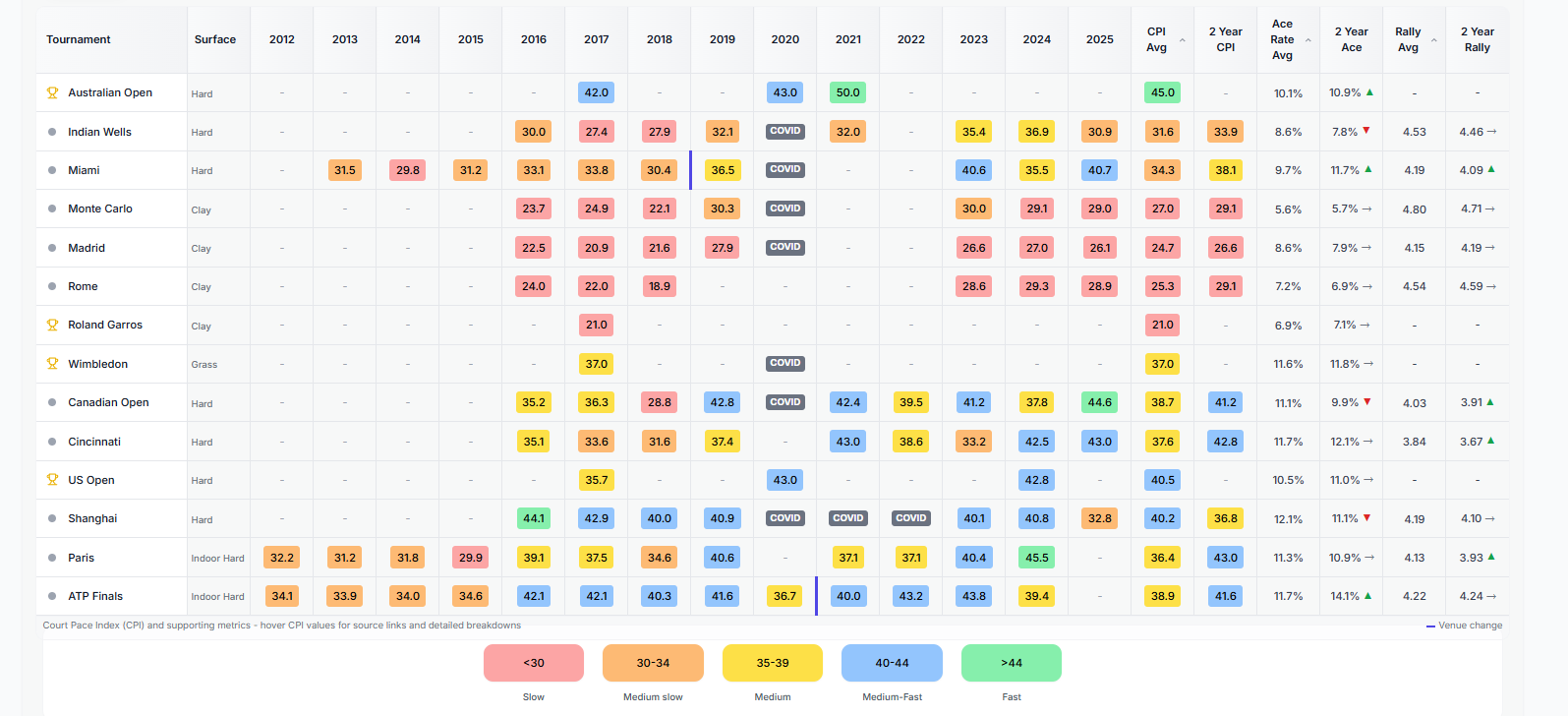
Here in a nice, easy-on-the-eye spreadsheet layout we can confirm court speed increasing almost universally across the slams and masters. I don’t think you’ll see a starker contrast than the Paris Masters going from a CPI of 29.9 in 2015, comparable to clay events, to 45.5 in 2024, a true fast court.
It’s well known that tennis courts slowed down significantly in the 2000s and the 2010s. Grass and hard courts were lightning quick and with serve and volley a dominant playstyle in men’s tennis, matches could end up never having a rally beyond four shots- serve, return, plus-one at the net and maybe a passing shot.
Slowing down courts was a deliberate effort to encourage longer rallies that would be more engaging to watch. It’s hard to deny the success of this strategy considering the golden years of the Big 4 era that followed from 2007 onwards. This generation of players were defined by their impeccable consistency from the baseline, leading to matches filled with epic rallies.
The Paris Masters recording a 29.9 CPI, marking it firmly as a slow hard court, is the ultimate symbol of this era. The biggest hard court events playing more closely to clay court speeds.
So, tennis courts have sped up since that period of slow courts of the 2000s and 2010s. Federer’s assertion appears to be wrong. However, there are still important questions still left to be answered. For me, those are why the courts have gone faster, whether that’s actually a good thing for the sport and Federer’s comments about court variety.
One answer as to why events have made efforts to speed courts up is that it’s a reactionary move. The courts got faster because the courts got too slow. It’s overcorrecting the court speed in the other direction.
I think you can see that in the data across multiple tournaments. The Paris Masters in 2015 has a CPI of 29.9 and jumps up to 39.1 in 2016, the speed adjustment also supported by the ace rate jumping from 10.5% to 13.7%. Paris in 2016 also ranked as the 10th fastest court on the ATP Tour by Tennis Abstract’s metric.
We can also see this in the jump in Cincinnati’s court speed more recently, going from a CPI of 33.2 in 2023 (Medium-Slow) to 42.5 in 2024 and 43 in 2025. Ace rate also climbed across these two years, up from 8.3% in 2023 to 12.3% in 2025.
Tournaments seek to cultivate a certain style of tennis and see certain players prosper within that, but once things become too extreme it becomes time to shift away from that model and reset.
I also wonder how much the uptick in court speeds in the 2020s in particular is down to the tennis balls being used. Players have consistently complained that the quality of the balls has gone down since Covid, often noting that balls fluff up and become heavier after just a few games of use.
Essentially this means that the balls become slower sooner, meaning that it’s harder to generate power and hit winners. Zverev discussed this at the ATP Finals last year:
“The main reason is that, due to COVID, the companies tried to cut costs using a different rubber material now. They are using a different material for the balls, making them on average 30% to 60% slower compared to how they used to be before COVID. It’s not just one company; overall, they are now worse and much slower, less consistent, and don’t last as long.”
It’s more a theory than any concrete explanation, but I think there’s a chance that part of the effort to speed up courts is to counteract the slower balls. Players have been consistently vocal in their frustrations with the tennis balls for several years now, so maybe this is a countermeasure.
The ball may be much slower off the racket and through the air once it’s fluffed up, but it won’t then lose even more speed when it hits the ground. Much slower balls on a much slower court can lead to a situation where it’s impossible to hit through the court.
Somewhat tied to this is also the increasingly pressing issue of heat and humidity. We’ve seen this most recently in Shanghai where it was swelteringly hot, consistently over 30 degrees in the day and above 60% humidity. No matter what time of day matches are on at, players are struggling to recover after longer rallies and ending matches drenched in their own sweat.
This has unfortunately been combined with Shanghai slowing down their courts, from a CPI of 40.8 to 32.8, making it the second slowest hard court in the Masters series behind Indian Wells.
With the players already struggling in the brutal humidity, the slower courts extend rallies even further and give no reprieve. It makes tough conditions even harder to play in and practically unwatchable as a spectacle.
It’s no wonder, then, that certain locations on the tour might want to have faster courts. The Australian Open being played in the full heat of the Aussie summer don’t want players suffering in the sun, for example.
The 2023 US Open was widely considered to have had a real dip in quality matches compared to previous years and I think court speed was part of that. Playing much slower than in 2021 and 2022, combined with extremely high temperatures and humidity made night sessions especially sluggish and turgid.
When the tennis calendar chases the sun in a world that’s only getting hotter, it’s fair to wonder if faster courts are a necessity for player welfare as well as spectacle. That perhaps also explains why so many events post-US Open are so fast, too.
The tennis calendar is far too long and by the time October rolls around everyone is feeling mentally and physically exhausted. The last thing players want this time of year is a slow hard court that forces them to grind out 10-shot-rallies every point.
It’s unsurprising, then, that Tennis Abstract’s speed rating ranks the European indoor swing including Basel, Antwerp, Paris and the ATP Finals in Turin as some of the fastest courts on tour.
The general consensus is that at this time of year, courts shouldn’t be physically taxing on players. Seeing Shanghai’s recent shift to slower conditions will likely only reinforce that belief.
When considering player welfare, the faster courts are probably a net positive for the sport. With the two-week Masters events leading to players being so fatigued by the end of the year, I don’t think you could justify returning to the slower courts of Paris or the ATP Finals from 10 years ago.
Efforts to make events played in the second half of the season slower have generally been met with negativity. One doubts whether Shanghai will want to keep their courts slower in 2026 after the reaction to this year’s edition of the tournament, for example.
However, whether this is “good for the sport” is about more than just what helps players. There is an entertainment factor here, a concern for the viewing experience. That is, of course, why tournaments made courts slower in the first place; it was about improving the product.
The question, then, is this: are faster courts “better” to watch than slower ones? And what does “better to watch” actually mean?
In the 2000s, the shift to slower conditions was about extending rallies. That is perhaps a good place to start, the belief that longer rallies are a more engaging viewing experience than short ones.
The highlights that consistently pop up on my Instagram, TikTok and YouTube Shorts feed are epic, extended rallies. Nadal-Djokovic at the 2011 US Open or that 26-shot Federer-Nadal rally at the 2017 Australian Open. Strangely enough, the many points of serve-plus-one don’t tend to dominate the highlight packages.
At the same time, there are plenty of long rallies that aren’t lighting up social media. I remember in 2023 the Australian Open’s YouTube channel ranked the best points of the year’s tournament, placing a 70-shot rally won by Jason Kubler versus Karen Kachanov at no.1.
Many comments were bemused because the rally was dominated by two minutes of Kachanov trading crosscourt backhands. While it’s certainly impressive consistency and stamina, it’s somewhat tedious to watch back such attritional tennis.
So, it’s worth saying here that longer rallies are not inherently more interesting and slow courts that encourage this are not inherently better. Some of the greatest matches of all time have come on fast courts, the worst match I have seen all year was in horridly slow conditions. Coco Gauff vs Quinwen Zheng in the late evening in Rome earlier this year was an error-strewn slugfest in part because the clay was so slow neither player could hit a winner.
The broader, more existential issue that men’s tennis in particular faces when it comes to court speed is the ever-increasing power of the serve. Players have only got taller and serves have only got better. Currently, there is only one player in the ATP Top 20 below 6’0’’ tall which is Alejandro Davidovich Fokina at 5’10’’.
A good server on the ATP can now hit up to 120-130mph comfortably. Combine this impeccable serving with faster courts and you have that same problem tennis saw at the turn of the century, too many short points.
So many points end with an ace, an unreturned serve or an easy plus-one shot from the server off a meek return. If your match is dominated by these types of points, it’s often not particularly engaging to watch.
This issue feels especially poignant as we roll into the last stretch of the season with the European indoor hardcourt swing to come. The ATP Finals has become a particularly tough watch for me since it moved to Turin and adopted lightning-fast courts, for example.
The average ace-rate for Turin (2021-2024) has been 15%, peaking at a staggering 16.7% in 2022. This made Turin the fastest court on the ATP that year by some distance with a Tennis Abstract surface speed of 1.50. Players were hitting 50% more aces in Turin than they would on a normal ATP surface.
Indoor conditions improving players serving by eliminating factors like wind, combined with faster courts that retain the full pace of a 130mph serve, unsurprisingly make for matches dominated by short points.
Watching players blast aces past one another for an hour is not fun. But as much as I find that dull, the conditions of Turin represent a form of variety compared to the rest of the tour. There are no other courts that play that fast anymore, so it is, in some ways, interesting to watch something so different.
In principle, I think lightning-fast courts like that are good because they’re unique. And yet I also think in the men’s game, lightning quick courts such as Turin can become basically unwatchable. How do I reconcile these two things?
Well, there’s two ways to reframe this more positively, one more pessimistic than the other. The first is that despite being dominated by big serving, super-fast courts can still offer interesting matches and high drama.
One of the best matches at Wimbledon this year was 6’8” Giovanni Mpetshi Perricard against Taylor Fritz played under the roof in round one. Despite so many points being the Frenchman bombing a 135mph serve, it was still a highly engrossing match because in the big moments Fritz landed his returns and got points going. Fast, serve-dominated matches can still be high on drama.
The less optimistic way of looking at quick courts is that while Turin may be less engaging to watch, it’s only one week of the year. The ATP’s showpiece event of the year, mind, but if you don’t enjoy that style of tennis, you don’t have to put up with it for long.
In a roundabout way I think this gets us to a core part of the problem once again. If every hard court on tour is playing medium-fast to fast, that’s a homogenous style of play for a majority of the year, one I personally find very dull to watch.
The uniformity makes for a lack of variety that goes against precisely what, in my view, makes tennis engaging. What is the point of travelling across the world to play in different continents, countries and cities that all play identically to one another?
Does tennis in Miami look particularly distinctive compared to Canada or Cincinnati? I would say not particularly. All are medium-fast to fast hard courts. If we factor in Shanghai and Paris’s recent histories as fast courts, over half the Masters series are fast hard courts.
How many “slow” hard courts are there on tour? Indian Wells stands out, as does Beijing and perhaps throw in smaller events such as Doha, Acapulco or Los Cabos into the mix. That’s about it.
This was something Federer also discussed in his interview with Roddick, lamenting that every court plays the same way now: “With the ball speed and the court speed, every week plays the same and that’s why you can just go from winning the French Open, Wimbledon and US Open playing the same way.”
Perhaps the issue, then, isn’t whether a certain style of court creates “good” tennis to watch. Rather, maybe the issue is much more about the variety of court speeds and conditions seen on the tour as a whole. I think that’s true…to some extent.
I don’t think this assertion that everything plays the same is entirely accurate, especially when Federer compares Roland Garros, Wimbledon and the US Open. The three surfaces play much closer together in speed, but they still offer tactical variety.
It’s first worth saying that the speed differences between the surfaces does still exist. There’s less data available about Wimbledon’s court speed but just compare the difference in ace-rate between Roland Garros and Wimbledon this year. 7.4% in Paris compared to 11.5% at Wimbledon.
Wimbledon is slower than it used to be, but it’s still much faster than clay. The other key distinction that still exists between tournaments is the differences in the bounce of the ball and the way surfaces react to spin.
The ball bounces higher and responds more to topspin on clay. The ball stays lower on hard courts and generally bounces even lower on grass. This does create meaningful differences in how surfaces play, encouraging different shots and spin profiles depending on the surface.
Alcaraz does not play the same type of shots on all three surfaces. On grass, for example, he employs the backhand slice much more. You won’t see him load up on top spin at Wimbledon or the US Open in quite the same way he often does at Roland Garros.
A lot of players aren’t adapting their games to different surfaces, but the very best who are winning tournaments across all three surfaces are. Those changes are not wholesale, these days it is more about how often you slice versus hit top spin or hit chipped returns, but that is variation.
I will admit that Federer’s assertion isn’t entirely wrong, Alcaraz and Sinner do broadly play the same overall style of tennis across the three surfaces. However, I would argue that’s more down to the evolution of the players themselves rather than the surfaces.
The very best players are just more complete now than they ever have been before, they are naturally going to be more “surface agnostic”. Djokovic, Alcaraz and Sinner don’t have any weaknesses in their game that can be exposed on any given surface. They are naturally going to have success in all types of conditions.
Compare them to, for example, the Next Gen cohort with the likes of Zverev or Tsitsipas. They have clear technical and tactical weaknesses such as Zverev’s forehand or Tsitsipas’s backhand that are more exposed on grass and empowered on clay.
Certainly, the Next Gen never really got to grips with grass and while there’s a lot of reasons for that, it’s clear the weaknesses each player possessed stopped them from having more success. None of this generation were able to have consistent success on all three surfaces in the way Federer describes.
The best players can play the same way across all three surfaces in part because they’re more similar but also because their base game is so complete and effective they don’t need to adjust. Federer himself did this, too, let’s not forget.
I think the more accurate statement might be that every hard court broadly plays the same way with few exceptions. As we’ve seen, a majority of big hard court events now play medium-fast to fast.
This gets compounded by the fact that a majority of the tennis calendar takes place on hard courts. If most of the calendar takes place on the same surface and the same conditions, we have a severe lack of variety on the tour as a whole.
There are all sorts of minor tweaks and changes each week that alter things in small ways, of course. Not every fast hard court is the exact same speed, different tournaments use balls from different manufacturers and there’s different weather conditions to contend with.
However, even with these small differences every week, these tournaments are not radically different from one another. Those adjustments to tactics and shot selection that comes with moving from clay to grass to hard do not apply here.
Maybe different fast hard courts take spin and bounce differently, but I do not think that is a massive change that totally transforms the style of tennis played on those courts.
One of tennis’s biggest strengths is its variety. Throughout the year you get to see players compete in different conditions, seeing different types of players thrive and different tactics have to be employed. The homogenisation of fast hard courts threatens that novelty. In short, we need more genuinely slow hard court events on the tour.
Tournaments do seem to still be willing to experiment with slower courts as we’ve seen with Shanghai and the US Open. It’s also worth saying that there is more representation for slow hard courts at the top of the WTA. Doha (an ATP250) and Beijing (an ATP500) are both WTA1000 events, meaning that there are more opportunities to see elite players on slow hard courts.
Personally, I prefer watching tennis played on slower courts than faster ones. I find that clay especially encourages variety and rewards tactical intelligence and diversity of style.
But what type of tennis you prefer to watch is all personal preference, and with that in mind I think the sport should do its best to try catering to all fans and play styles. At the moment, the data shows that isn’t happening.
I’m sure change will come eventually and in another ten years’ time data shows courts have all been significantly slowed down again in response to a gradual speed up across the board and we’ll have a new problem on our hands.
And I’m also sure that in the meantime, the general consensus will be that the courts are too slow, that hard courts still play like clay and that we just need to speed everything up because there’s no lightning-quick courts anymore. Of course, one can always hope that perceptions might change.
Tennis Abstract ATP Surface Speed Rating: https://tennisabstract.com/reports/atp_surface_speed.html
Tennis Court Speed website: https://courtspeed.com/
Roger Federer’s interview on Served with Andy Roddick:
The similarity of hard court speeds across the tour is definitely something that needs fixing. If we want different playstyles and tactics then we need an environment that encourages experimentation.